News
How to Size a Vertical Slurry Pump for Your Sump
Sizing a vertical slurry pump starts with your sump, not a catalogue page. This guide explains how slurry properties, sump depth and duty data decide the right pump size for reliable sump service.
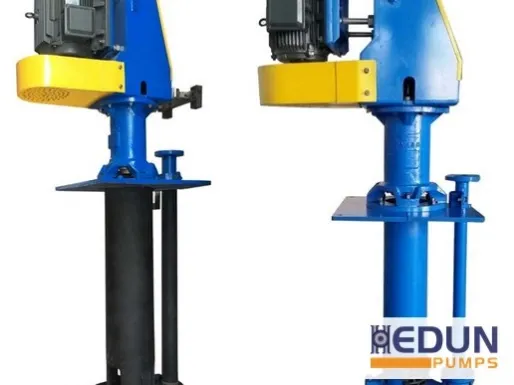
A vertical slurry pump is sized from the sump it sits in, not from a catalogue page. This guide covers the five sizing steps — slurry, sump, flow and head, materials, drive — so the pump you order fits the pit it has to work in.
What a vertical slurry pump is
A vertical slurry pump, also called a vertical sump pump, hangs down into a sump or pit. The pump end is submerged, the shaft runs up through a column, and the motor sits above the liquid level on a mounting plate. There are no submerged bearings and no shaft seal below the liquid — that cantilever design suits dirty sumps. It needs no priming: as long as the pump end is covered, it starts pumping. It is the standard choice for sumps, floor drains, mill spillage pits and tailings sumps. It is not a transfer pump — for long pipelines, use a horizontal pump.
Step 1 — Know your slurry
Sizing starts with what the pump has to move. The largest particle size decides the impeller passage and the pump size: a pump that cannot pass the largest particle will block or wear out its impeller. Solids concentration by weight decides wear rate and power; a pump sized on one low-concentration sample will overload when the slurry thickens. Specific gravity matters because slurry is heavier than water, so head and power must be corrected for it — a clean-water figure understates the motor size. A corrosive slurry points to rubber wet-end parts, while coarse, sharp solids point to high-chrome metal. Send these figures with your enquiry.
Step 2 — Measure the sump
The sump decides the pump's length, the one figure that cannot be fixed later. Measure the depth from the mounting plate to the sump floor: the submerged length must reach below the minimum liquid level with margin, so the pump end stays covered when the level drops. Note the minimum and maximum liquid levels — the pump must stay covered at the lowest level and the motor clear at the highest. Check the sump size and access: the plate must cover the opening. Too short runs dry and wears fast; too long costs more and is harder to install.
Step 3 — Flow and head
The duty point is the flow the sump needs and the total head against it: the static lift to the discharge point plus the friction loss of the discharge line. Long or small-bore lines add significant head, and underestimating it is the most common sizing mistake after the sump depth itself. The pump should run near its best efficiency point at the normal duty: far oversized, it wastes power and wears its parts through low-flow recirculation; undersized, it cannot keep up with the inflow and the pit overflows.
Step 4 — Pick the wet-end material
The wet end — impeller, volute liner and throat bush — takes all the wear. High-chrome white iron suits coarse, sharp solids and higher heads: hard and wear-resistant, but brittle under heavy impact. Rubber suits fine, rounded particles and corrosive slurries: it absorbs impact and resists chemical attack, but not coarse, sharp solids at high head. The slurry decides the material — and how long the pump runs between liner changes.
Step 5 — Drive and installation
The motor sits above the liquid on the mounting plate, belt-driven or direct-coupled — check the available power supply before ordering. The pump needs no priming and no foot valve, but the sump must be kept free of tramp material such as rags, timber and large rocks, which can block the inlet. For sumps where solids settle and harden, ask about an agitator option to keep solids in suspension near the inlet.
Three sizing mistakes to avoid
- Choosing by discharge diameter alone. Size from flow, head and particle size, not pipe size.
- Ignoring the minimum liquid level. A pump sized for the average level runs dry at the lowest level.
- Using clean-water head and power figures. Slurry head must be corrected for specific gravity, and the motor sized for slurry power.
What to send HEDUN for a sizing
Slurry: material, largest particle size, concentration by weight, specific gravity, corrosive or not. Sump: depth from mounting plate to floor, minimum and maximum liquid levels, opening size. Duty: required flow, discharge pipe length and elevation, continuous or intermittent running. Send these, plus the power supply available at site, and HEDUN will propose the pump size, material and drive.
Summary
A vertical slurry pump is sized from the sump and the slurry, in that order: measure the sump depth and levels, define the slurry, then fix flow, head and materials. HEDUN HDV vertical sump pumps come in a range of submerged lengths and materials, with dimensions interchangeable with Warman® SP series sump pumps.
WARMAN® is a registered trademark of Weir Minerals. HEDUN is not affiliated with or authorised by Weir Minerals.
FAQs
- What is a vertical slurry pump, and when do I need one? A vertical slurry pump hangs into a sump or pit with its pump end submerged and its motor above the liquid level. Use it to collect slurry from sumps, floor drains, mill spillage pits and tailings sumps. For moving slurry over a long pipeline, use a horizontal slurry pump instead.
- How deep can a vertical slurry pump go? It depends on the sump depth — the pump's submerged length is built to match the distance from the mounting plate to the sump floor, and it must reach below the minimum liquid level. Send HEDUN the sump depth and levels and the length will be matched to your sump.
- Metal or rubber wet-end parts — which should I choose? High-chrome metal suits coarse, sharp solids and higher heads. Rubber suits fine, rounded particles and corrosive slurries. For mixed duties, send the slurry details and HEDUN will recommend a material.
- What happens if the sump runs dry? The pump end must stay covered. Running dry causes cavitation and rapid wear of the impeller and liners. Size the pump length for the lowest liquid level the sump actually reaches, and use level control to stop the pump before the level drops too far.
- What information do I need to send for a vertical pump sizing? Slurry details (material, largest particle size, concentration, specific gravity, corrosive or not), sump depth and liquid levels, required flow and discharge line details, and the power supply available at site.